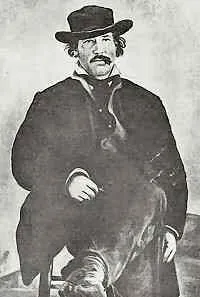
Stand in the Moreno Valley today, with Baldy Mountain at the head of the valley and the ski slopes of Angel Fire behind you, and nearly everything under your feet was once part of a single private estate. The Maxwell Land Grant covered 1,714,765 acres in what is now Colfax County, New Mexico, and part of southern Colorado, and its southeastern boundary reached westward almost to the ground where Angel Fire Resort stands today. For a generation the valley answered to one man, Lucien Bonaparte Maxwell, and in 1870 that man decided to sell.
Maxwell had come to the grant through his wife, Luz Beaubien, whose father, Carlos Beaubien, received the original grant with Guadalupe Miranda in 1841. After Beaubien died in 1864, Lucien and Luz bought out the other heirs, and their holdings peaked at the full 1,714,765 acres. Maxwell ran the estate from his large home in Cimarron, made money supplying beef and other goods to Fort Union, and when gold was discovered near Baldy Mountain in the late 1860s, he leased ground to the miners of Elizabethtown and sold them supplies. People who settled, farmed, and mined on the grant generally did so with his blessing, in the loose, personal way of the old Mexican land system.
The sale was built in stages. On May 6, 1869, Maxwell gave an option on the grant to a group associated with Jerome B. Chaffee, Wilson Waddingham, George M. Chilcott, and Charles F. Holly, at a price of 650,000 dollars. On April 30, 1870, that option passed to the newly formed Maxwell Land Grant and Railway Company, an English and Dutch concern, and on June 12, 1870, the company took it up for 1,350,000 dollars, less than a dollar an acre for one of the largest private landholdings in American history. Even Maxwell's 1,000-acre home ranch, held out of the first sale, was bought that August for another 75,000 dollars. Dutch investors were then found to issue 5,000,000 dollars in stock in the new company.
For the Maxwells, the era ended quickly. Lucien and Luz left Cimarron, and Lucien retired to Fort Sumner, the old army post down on the Pecos River, where he died on July 25, 1875. The valley he left behind belonged to directors and bondholders overseas, men who had never seen Baldy Mountain or the Moreno Valley and who intended to develop the grant's coal, timber, ranch, and farm lands as a business investment.
That change in ownership changed life in the valley. The new company tried to collect rent from the families already living on the grant and to expel those who refused to pay, while the inhabitants answered that Maxwell himself had given them the right to be there. The protests that followed, including the burning of the company office at Elizabethtown in October 1870, opened more than a decade of conflict and court fights. The foreign company itself did not last in its first form: its bondholders foreclosed in 1878, and a reorganization completed on May 3, 1880, transferred the grant to a reorganized Maxwell Land Grant Company. The land was eventually sold off in pieces over the following century, and it was from that same land grant company that the LeBus family later bought the Moreno Valley ranches that became Angel Fire. Did you know that the resort town in the pines traces its land title back to a sale closed for less than a dollar an acre?