Did you know that the first permanent settlement in Colfax County began not in a mountain valley, but out on the open plains east of the Sangre de Cristo Mountains? Lucien Maxwell founded Rayado in 1848, at the end of the Mexican-American War, where the mountain branch of the Santa Fe Trail met the Cimarron Trail. It was the first plains settlement in New Mexico east of the mountain valleys, and its name, Rayado, comes from the Spanish word for streaked, perhaps for the lot lines Maxwell marked out there.
Maxwell had land, stock, and big plans, but he had trouble persuading families to settle where Apache and Comanche raids were still a real danger. So in 1849 he convinced his old friend Kit Carson to move down from Taos and lend the young settlement an air of safety. Carson put about 2,000 dollars of his own savings into the venture, and together the two men bought stock and seeds and hired workers to raise buildings along Rayado Creek. Maxwell built a large house, and Carson built a smaller adobe home nearby, and their ranch soon became a familiar stop for traders traveling the Santa Fe Trail.
The danger Maxwell worried about was not imagined. A federal garrison post was established at Rayado in 1850, when a detachment of United States Army Dragoons was based there, and the post lasted until Fort Union was opened. Carson himself stayed only a few years before returning to Taos, but his presence in those first seasons helped Rayado hold on long enough to become a lasting community, with homes built around a placita, or courtyard, arranged in part for protection.
In 1857 Maxwell left Rayado to found Cimarron, and his brother-in-law Jesus Gil Abreu and the Abreu family took over the running of the Rayado ranch. Abreu had his ranch house on the banks of Rayado Creek from 1859, and the settlement kept serving travelers for decades. La Posta, a stage stop dating from about 1850, also worked as a trading post, and Rayado kept a post office from 1873 to 1919, long after many trail towns had faded away.
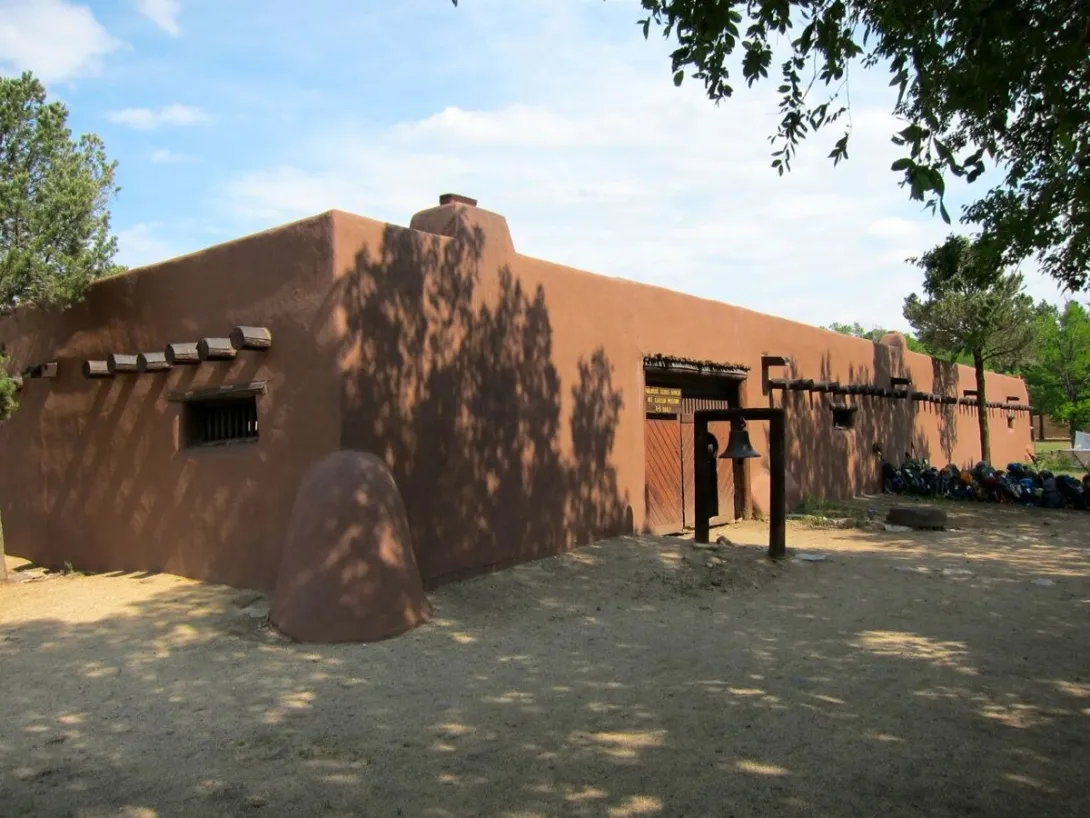
Today Rayado is part of Philmont Scout Ranch, south of Cimarron on New Mexico Highway 21, and its story is told at the Kit Carson Museum. Scouting America built the adobe museum in 1950 as a re-creation of a New Mexican Territorial Style home, and its staff, in period clothing, demonstrate the frontier skills Carson and Maxwell would have known, including blacksmithing, cooking, shooting, and farming. Nearby stand the Maxwell-Abreu house, the Martinez house, the Chapel of the Holy Child, and La Posta itself, so a drive over the hills from Angel Fire and the Moreno Valley still leads straight back to the Cimarron country where Carson tried, for a few years, to trade a roving life for a home.