
If you pick up almost any pale, glassy stone around Angel Fire, there is a good chance you are holding quartz in one of its two common local forms. As milky white veins, it cuts through the dark mountain rocks west of town. As quartzite, it builds whole ridges. Learning to tell the two apart is one of the easiest ways to start reading the Moreno Valley, because both forms tell the same deep story of sand, burial, heat, and uplift in the Sangre de Cristo Mountains.
Click to see more photos of quartzite in New Mexico
The quartzite came first, and it is very old. Geologic mapping by the New Mexico Bureau of Geology and Mineral Resources in the Red River and Wheeler Peak country, just west of the Moreno Valley, shows Precambrian rocks underlying much of the high country. Those rocks include thick quartzite that began as clean quartz sand more than a billion years ago. Buried and metamorphosed, the sand grains fused into a hard mass that is commonly 95 to 99 percent quartz. Later, Laramide uplift raised the Sangre de Cristo range, and the Moreno Valley took shape beside it as a broad fold filled in part by much younger valley gravels.
Vein quartz is the younger, flashier relative. Hot fluids moved through cracks in the old rocks and left milky white quartz in veins, sometimes with minor sulfides noted by geologists in the Red River and Wheeler Peak area. Erosion then did the sorting for us. Streams carried tough quartz and quartzite cobbles down from the mountains and spread them through the late Pliocene and early Pleistocene gravels that accumulated in the Moreno Valley, which is why rounded, glassy pebbles turn up so often in valley gravels today.
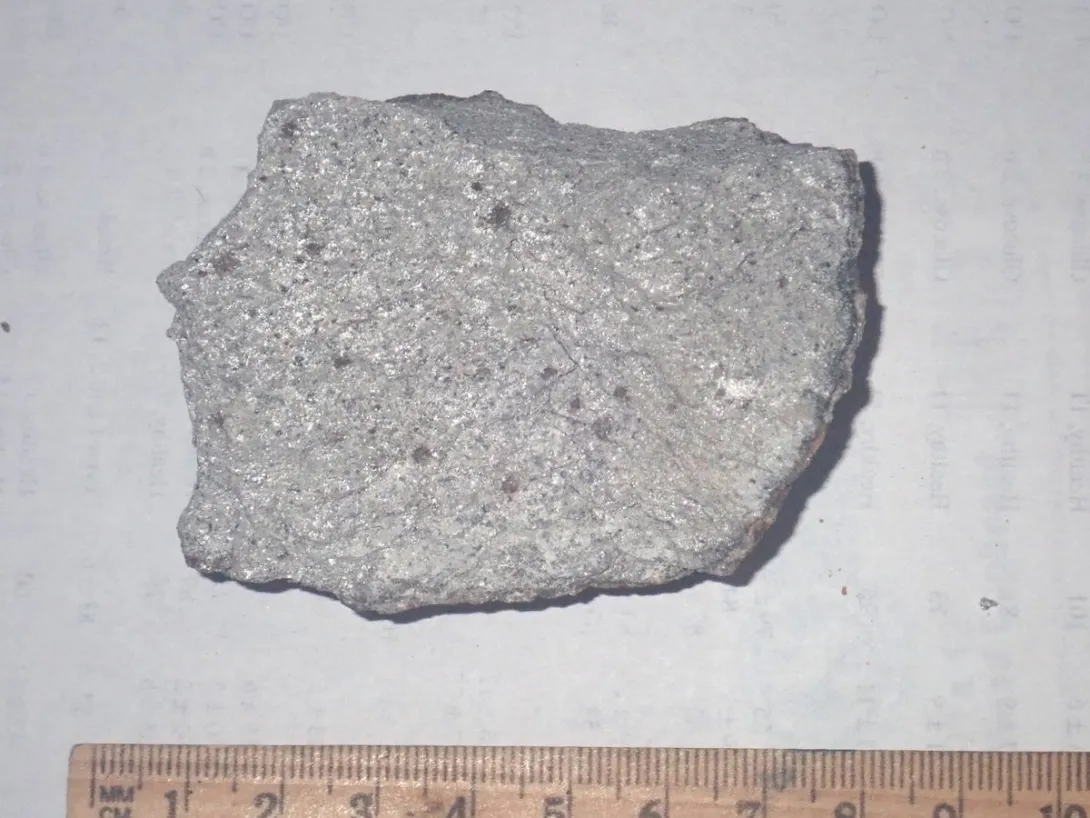
In the hand, quartz gives itself away in three ways. It is hard, at 7 on the Mohs scale, so a steel knife will not scratch it. It has a glassy, or vitreous, luster and no cleavage, breaking instead with smooth, curved, shell-like fractures. Quartzite looks different: it has a sugary, sparkly surface of fused grains, and it breaks across the grains rather than around them the way a sandstone does. A gray, glittering hand sample like the one pictured here, from similar Precambrian quartzite in the Picuris Mountains of New Mexico, is a fine example of what to look for when you are simply observing and learning.
Know before you go
Collect only where legal, and confirm the land manager and the current rules before you collect anywhere. No specific collecting site is named in this article, because no site near Angel Fire was verified as open to collecting this week. Much of the Moreno Valley is private ranch and resort land, and collecting there requires the landowner's permission and must never involve trespassing. The Baldy and Elizabethtown country is laced with mining claims, and collecting on a claim is prohibited without the claimholder's permission, and old mine workings must never be entered. On Bureau of Land Management land, rockhounds may generally collect reasonable amounts of rocks and minerals for personal, noncommercial use with hand tools and only minor surface disturbance, but not in developed recreation sites. On National Forest land, personal-use collecting is generally allowed with minimal disturbance, and you should check first with the local ranger district. New Mexico state parks prohibit removing rocks, and wilderness rules are stricter still. Wherever you go, pack out what you pack in and leave the ground as you found it.