
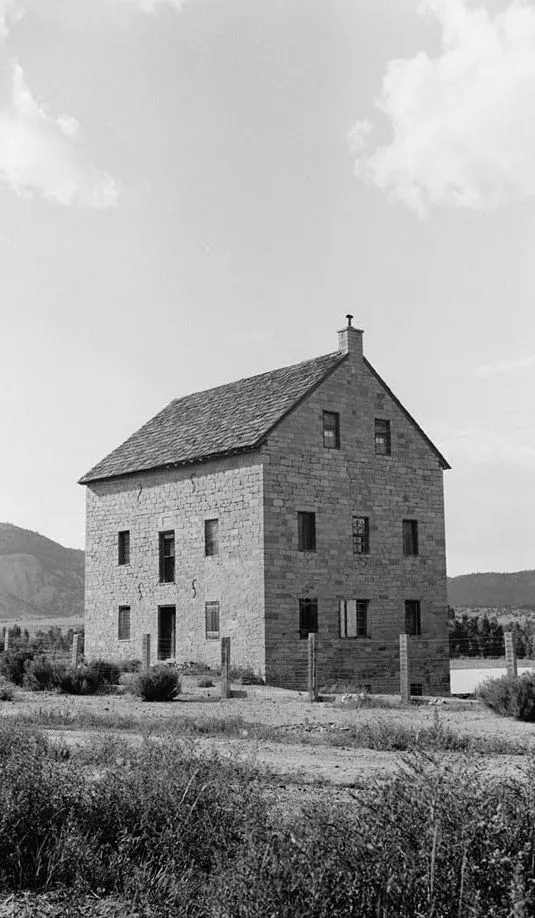
Did you know that one of the hardest-working buildings of the Maxwell Land Grant era still stands in Cimarron, at the eastern foot of the mountains above the Moreno Valley? The Aztec Mill, a tall stone gristmill built in 1864 for Lucien B. Maxwell, was raised in the very year Maxwell bought out the other heirs of Carlos Beaubien and became the largest individual landowner in the United States, master of 1,714,765 acres that reached from the Colorado line down past the valley where Angel Fire stands today.
Click to see more photos of the Aztec Mill — the stone mill, its machinery, and its museum years
Maxwell built the mill at serious expense, about 48,000 dollars, and it was no country trifle. By 1864 it was producing 44 barrels of flour a day, grinding wheat and corn for local residents and for soldiers, and its flour traveled to Fort Union, the great Army post that guarded the Santa Fe Trail. One detail made it unusual for its time: its waterwheel stood inside, on the ground floor, so the mill could keep turning through the winter instead of stopping when the Cimarron River froze.
The mill quickly became more than a mill. In 1861 the federal Indian Agency had been moved from Taos to Cimarron, and some 1,200 acres of nearby grant land were farmed for the agency. The Aztec Mill became the staging ground where blankets, meat, flour, grain, and other rations were dispensed to the Jicarilla Apache and Moache Ute people of the agency, and to local citizens as well, with Maxwell compensated by the federal government for the supplies his operation provided.
The mill's working life was short, and it rose and fell with Maxwell himself. It operated until 1870, the same year Maxwell sold the grant to English and Dutch investors and retired to Fort Sumner. The gold rush that began on Baldy Mountain in 1867, above the Moreno Valley, had already changed the country around it, drawing thousands of newcomers onto grant land and straining the old agency system, and the stone mill settled into quieter years after its owner left Cimarron.
The building had a second life, and it is the reason visitors can still walk through it today. Fred Lambert, the Cimarron lawman who was born in the St. James Hotel in 1887, later restored the old mill as a museum of the region. Listed on the State Register of Cultural Properties on December 20, 1968, and now known as the Old Mill Museum, the mill anchors the Cimarron Historic District with three floors of photographs, tools, and clothing from Colfax County's early days. Standing before its stone walls, it is easy to picture the wagons, the sacks of wheat, and the valley empire it once fed.