
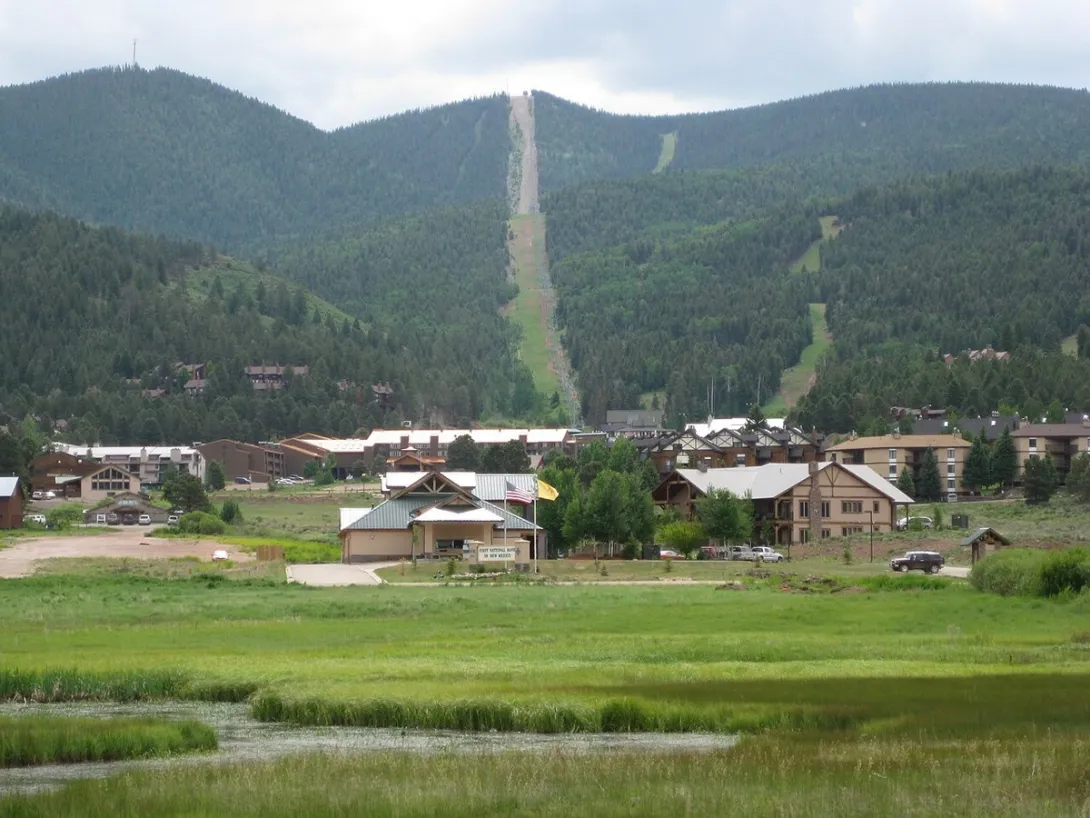
Angel Fire is an unusual New Mexico town. The Village of Angel Fire, in the southwest corner of Colfax County, holds the oldest water rights in the Moreno Valley, yet it is the valley's youngest municipality. Its story began as ranchland: Roy and George LeBus bought the Cieneguilla Ranch from the Maxwell Land Grant Company in 1954, ran cattle and logging there, and opened Angel Fire Ski Resort to the public in the winter of 1966, with a small country club, a nine-hole golf course, a 40-acre Monte Verde Lake, and a dirt airstrip. A resort had been planted in a cattle valley, but a town still had to grow around it, and the hardest growth came in the 1980s and 1990s.
The Village of Angel Fire was incorporated on July 1, 1986, in the middle of that uncertain period. Its original boundary was narrow, limited to properties along North Angel Fire Road from the base of the ski mountain to the intersection with State Highway 434, and upon incorporation the new village adopted a General Plan to manage development and guide its future. Becoming a municipality gave valley residents a government of their own, separate from whoever owned the resort in any given year, and that separation would soon matter a great deal.
The resort itself changed hands repeatedly. The LeBus family had sold it to the Baca Grande Angel Fire Corporation in 1972, and the Village's own history records that it was subsequently sold several times between 1983 and 1996. Those decades brought a national recession, prolonged legal battles, and, in 1993, a Chapter 11 bankruptcy: the Angel Fire Corporation, which owned the resort at that time, and other related debtors filed for reorganization under the federal Bankruptcy Code. For a one-industry town, the question was whether the ski area would survive, and whether the thousands of property owners in its subdivisions would keep the access to the ski area, golf course, country club, and other amenities they had been promised.
The bankruptcy produced an answer that still shapes Angel Fire today. Angel Fire Resort Operations agreed to purchase assets and liabilities from the bankrupt estate, including real property interests in the amenities, under a reorganization plan accepted by the classes of claimants, including the property owners. To settle a lawsuit arising from that process, the resort recorded a Supplemental Declaration of Restrictive Covenants and Easements, designed to clarify and make uniform the amenity rights of property owners. The plan fixed the annual dues assessment for the 1995-1996 season and allowed it to rise afterward only by the increase in the Consumer Price Index. In plain terms, the rights of ordinary lot owners were written down and protected, not left to a bankrupt company's fortunes.
While the resort worked through its troubles, the young village kept growing into its role. Through a series of annexations from 1991 to 1998, its boundaries expanded to 28.8 square miles, taking in all of the subdivisions previously developed and managed by Angel Fire Resort. Then came the turning point: in 1996 the resort was purchased by the brothers Tim and Greg Allen, and, as the valley's histories put it, most disputes were settled that year and a new ownership group provided a brighter future for Angel Fire. The ranch that became a resort had also become a village, one that learned, the hard way, how to hold together when its founding business faltered, and that resilience is part of the heritage every visitor skis, golfs, and fishes in today.