Did you know that one of the Moreno Valley's first cattlemen reached New Mexico by crossing an ocean to avoid a war, and then promptly enlisted in another army? Patrick Lyons was born in February 1831 at Kilriney, in County Kildare, Ireland, and was educated in the national schools of his native land. In 1854 he was drafted into the English army for the war between England and Russia. To avoid that service he came to America instead, landing in New York, where, strange to say, he immediately enlisted in the First Regiment of Mounted Rifles.
That regiment carried Lyons west. The command had headquarters for a time at Fort Leavenworth, Kansas, then came on to Fort Union, New Mexico, and took part in the Navajo war. Lyons remained in the army five years, years of almost constant Indian fighting, and during that time he had the good fortune never to be ill or in the hospital. He was present at the fighting at Pigeon's Ranch, in the detail that attacked the rear of the Texan army. In 1862 he left the army and entered the service of the United States commissary department, herding cattle for the government, which he continued for a year and a half. It was his first taste of the cattle business, and it was not his last.
Like so many restless men of his generation, Lyons kept moving. He went to Virginia City, Montana, on a prospecting tour and spent two years mining, at first working for wages at fourteen dollars per day. He trapped and hunted on the Laramie River near Fort Laramie, where one winter he had charge of a herd of cattle for a man named Ward, and he worked two years in the quartermaster's department at old Fort Riley. From Kansas he came at last to Elizabethtown, New Mexico, in the Moreno Valley gold country, and was among the first to begin mining operations in Grouse Gulch. He also opened Michigan Gulch, at first working by the day for a company. Afterward he bought out the company, with the exception of one man, John Moore, and continued mining successfully for three or four years.
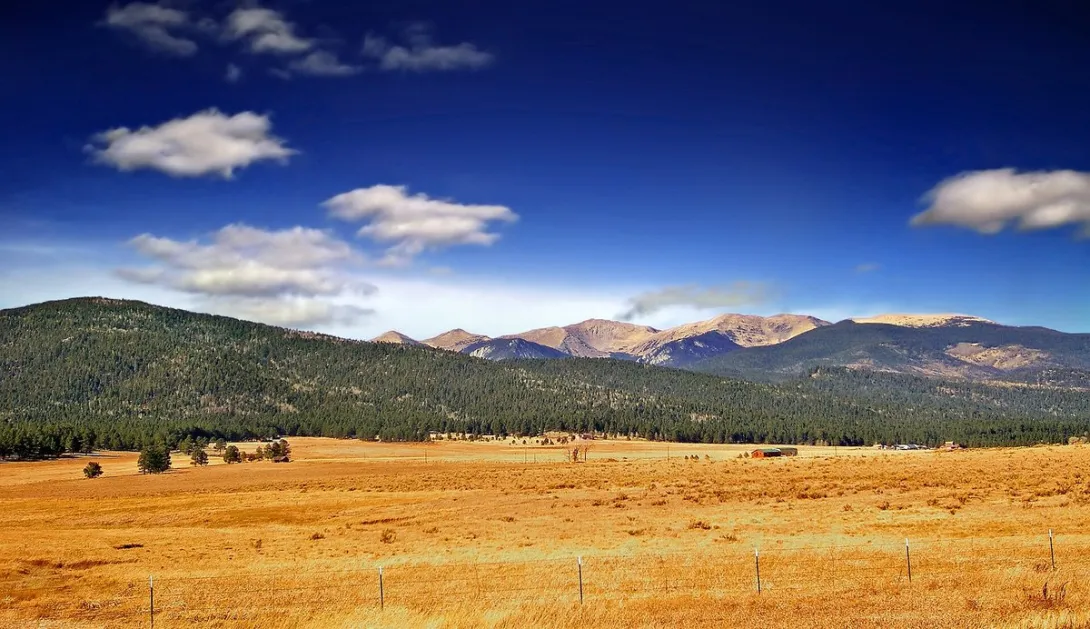
Then Patrick Lyons went into the cattle business in earnest, and the Moreno Valley became his range. First he bought about 200 head of milch cows, and to this herd he added some fine Kentucky bulls. He took his stock into the Moreno Valley and Comanche Gulch, the high, grassy country at the head of the valley below Baldy Mountain. He had four ranches in Van Bimmer canyon, with twenty-two miles of grazing land. In time, these claims he subsequently sold to the Maxwell Land Grant Company, the great land company whose grant covered the valley.
Lyons had previously bought a place in Taos County, and in the 1880s he came and located there permanently, afterward buying an adjoining place, and there he made his home and devoted his time to farming. He and his wife, the former Miss Lucy Pew, were the parents of two daughters, Mary and Lulu. When the History of New Mexico recorded his life in 1907, it counted him among the prosperous and prominent ranchers of Taos County. His road, from an Irish draft notice to a soldier's saddle, a miner's gulch, and finally a cattleman's herd grazing the Moreno Valley, is the valley's own story in one life: gold drew men like Lyons to these mountains, but it was the grass that gave them a reason to stay.