
Did you know that some of the richest gold ground in the Moreno Valley nearly stayed in the dirt for want of water? When prospectors found placer gold in Willow Creek and the gulches on the west side of Baldy Mountain in 1866 and 1867, they found it in gravel that had to be washed to give up its color. The valley's own creeks were small and uncertain, and the hard winters shut work down for months. From the very first rush, the miners understood that Elizabethtown's future depended less on finding more gold than on bringing in more water.
Their answer was audacious. The Moreno Water and Mining Company, whose original members included Lucien B. Maxwell, Captain W. H. Moore, William Kroenig, John Dold, Colonel V. S. Shelby, M. Bloomfield, and Captain N. S. Davis, set out to steal a river. Davis, an engineer of the United States Army, surveyed the route, and work began on the Big Ditch on May 12, 1868. The ditch diverted nearly 1,000 cubic feet of water per minute from the headwaters of the Red River, at a point only about eleven miles west of Elizabethtown in a straight line. To hold its gentle grade across the mountains, however, the ditch had to wind for forty-one and a half miles.
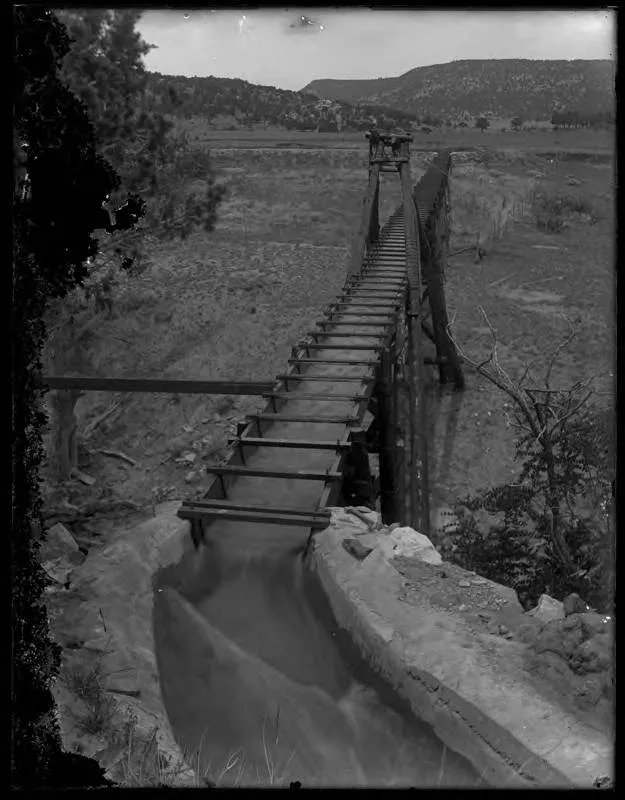
Crews built three large lakes along the line to serve as reservoirs, and several smaller reservoirs on Baldy Mountain above the placers, so water could be stored and released to work the hydraulic giants below. Remarkably, the work was practically complete within six months, and the final cost, including the reservoir construction, came to about 230,000 dollars. Writing a century later, geologist R. F. Pettit Jr. noted that parts of the original flumes could still be found clinging to the sides of vertical cliffs, in places that made a visitor wonder how the builders had ever put them there.
Then came the heartbreak. Seepage from the ditch and leakage from the flumes lost the major portion of the water along the way, and the amount finally delivered was only about 75 cubic feet per minute, a small fraction of what had been diverted. The first water reached Humbug Gulch on July 9, 1869, more than a year after construction began, and the company was soon in financial difficulties. Its assets passed into the hands of Colonel Shelby, who had loaned much of the construction money, and Maxwell himself was the next owner. He could not make the ditch pay either, and in 1875 he sold it to Matthew Lynch.
Lynch, the father of hydraulic mining in New Mexico, finally made the Big Ditch work. He sold its water at very high rates and used much of it in his own large placer operations, running three or four hydraulics in a season. After his death in 1880, his brothers James and Patrick Lynch operated the ditch for a number of years before it gradually fell into disuse. Today the gold camp it served is a quiet ghost town beside New Mexico State Road 38, but the ditch's long, level trace still crosses the mountains between the Red River country and Baldy Mountain, a reminder that in the Moreno Valley, water was always worth more than gold.