
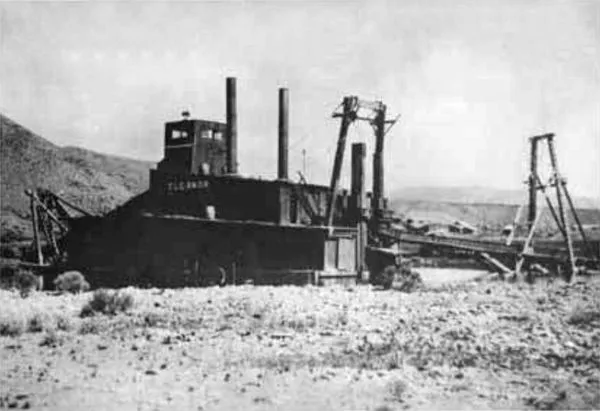
For its first thirty-five years, Elizabethtown's gold came up the hard way, in pans, rockers and sluice boxes worked by hand along Willow Creek and the Moreno River. In 1901 the machine age arrived in the Moreno Valley in the form of a floating gold mine. The Oro Dredging Company, led by its president, H. J. Reiling of Chicago, brought a monstrous dredge to the creek below E-Town and christened her the Eleanor.
Click to see more photos of Elizabethtown — the Eleanor dredge, the old town, and the Moreno Valley
Getting Eleanor to the valley was a feat in itself. Piece by piece, the dredge was hauled from the railhead at Springer across mountain roads and streams. The company built a dam three miles from Elizabethtown and floated the biggest pieces in on a large boat. When she was assembled, her machinery alone weighed 350,000 pounds, a steel giant resting in a high mountain creek nearly two and a half miles below the town she was meant to revive.
Eleanor began production in August 1901, and she worked on a scale the old placer miners could scarcely have imagined. She handled 4,000 cubic yards of dirt every day, and an electric plant on board let her run twenty-four hours without stopping. The gravel she chewed through was worth from thirty cents to three dollars a cubic yard, and for a time she was the only mining dredge operating anywhere in New Mexico. Reiling knew the business well: he had pioneered this kind of dredging by introducing the first dredge into the gold fields of Montana.
Her first year repaid the faith placed in her. Eleanor paid for herself and cleared more than 100,000 dollars, producing about one-quarter of all the gold found in New Mexico that year. For a town that had shrunk from several thousand residents in its 1869 prime to a quiet remnant, the dredge's steady churn was proof that the Moreno Valley gold story was not finished yet, even if the work now belonged to a machine and a Chicago company rather than to a thousand men with pans.
The triumph did not last. Eleanor's owner mortgaged the dredge to finance a similar venture in Colorado, the following year turned unprofitable, and bankruptcy followed. The dredging operation finally ended in 1905, and Eleanor was left where she floated, to rust and slowly sink into the sands of Moreno Creek. Her buried remains are still there, the histories say, though no trace of her can be seen today. Drive New Mexico State Road 38 past Elizabethtown now and the valley is quiet grass and stone ruins, but below the surface lies the largest gold miner the valley ever knew.