
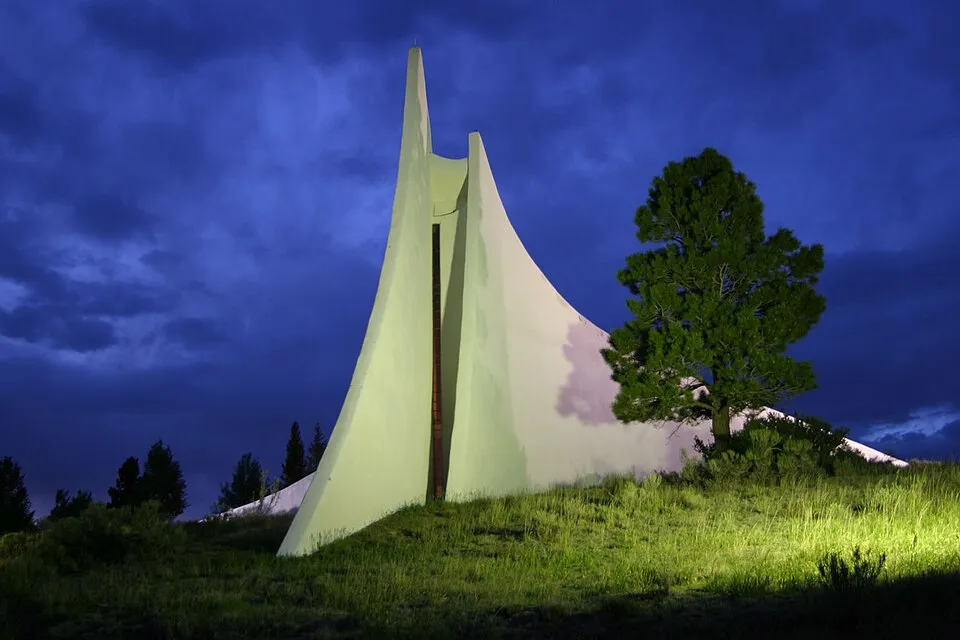
Everyone who drives U.S. Highway 64 above Angel Fire knows the white chapel on the hill, its curves sweeping fifty feet upward over the Moreno Valley. Fewer people know the man who raised it. Dr. Victor Westphall, known to generations of veterans simply as Doc, was a historian by training and a veteran himself long before he became a builder. He entered the United States Navy in 1943 as an ensign and served in the South Pacific during World War II, setting up message centers that kept front-line units in communication. After three years in uniform he brought his wife, Jeanne, and their two sons to New Mexico, earned his doctorate in history at the University of New Mexico, and became a leading author and expert on the history of the Southwest.
Click to see more photos of the Vietnam Veterans Memorial — the chapel, the Huey helicopter, the gardens, and the inscribed memorial bricks
That scholar's life changed forever in May 1968, when word came that his son David, a Marine first lieutenant, had been killed in an ambush near Con Thien, South Vietnam. It was Jeanne who suggested that David's life insurance money be used to build something lasting, and Doc agreed. He hired Santa Fe architect Ted Luna to design a sanctuary on the family's hillside above the valley, and construction of the Vietnam Veterans Peace and Brotherhood Chapel began in the fall of 1968. The chapel was dedicated on May 22, 1971, exactly three years after David's death. It was the first major memorial in the United States created to honor the veterans of the Vietnam War, standing above the Moreno Valley more than a decade before the national Wall was completed in Washington in 1982.
Building the chapel, it turned out, was only the first half of Doc's work. Keeping it alive was the second. The Congressional Record would later note that he struggled to find financial support for the memorial but remained dedicated to the project year after year, giving the place his time, his money, and his property. Recognition slowly followed the perseverance. In 1987 the United States Congress recognized the memorial as a memorial of national significance. In 1988, Jeanne and Doc founded the David Westphall Veterans Foundation, a nonprofit created to find permanent support for the memorial they had started with an insurance check and their own hands. At the chapel entrance, visitors still pass words written by David himself, a poem of his that his father placed where every guest would meet the son before meeting the story.
Dr. Westphall died on July 22, 2003, at the age of eighty-nine. A week later the United States Senate paused to honor him, and Senator Pete Domenici closed his tribute with a single sentence of summary: he gave his son, his time, his money, his property, and his life to honor our fallen heroes. Jeanne died the following year, and both of them are buried at the memorial they built. In 2008 the New Mexico Legislature formally asked the state's congressional delegation to seek a Congressional Gold Medal for Doc, in recognition of a stand he had taken for honor in a divided time. The historian who spent his career writing down the Southwest's past had ended by building one of its most enduring places of memory, and the chapel he raised for David now keeps his own story too.