
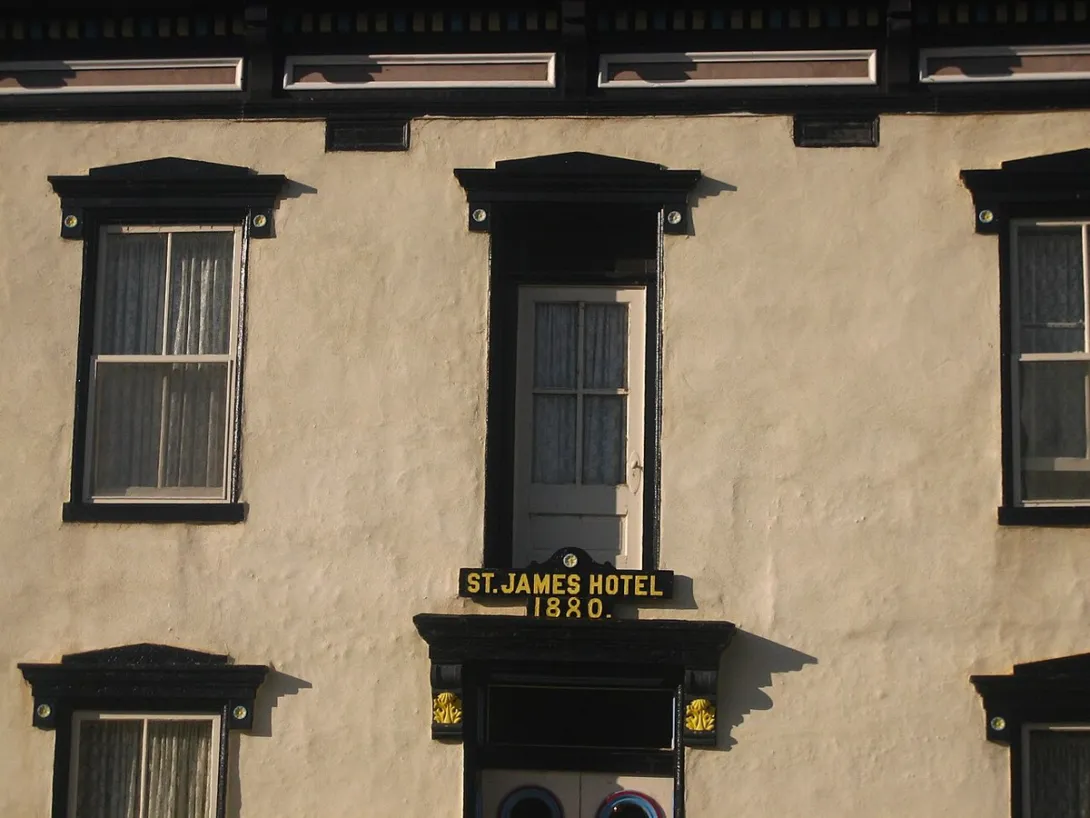
Charles Fred Lambert was born on January 23, 1887, in Room 31 of the famous St. James Hotel in Cimarron, New Mexico, the son of Henri and Mary Lambert. His father, a French immigrant who had once cooked for President Abraham Lincoln, built the hotel in 1872 as Lambert's Inn, and it became one of the most notorious stops in the Cimarron country. Family tradition holds that a hotel guest that blustery winter night, Buffalo Bill Cody, became the boy's godfather and later taught him to shoot during his visits to Cimarron.
Click to see more photos of Fred Lambert — on the Cimarron Ranch in 1907, at the St. James Hotel, and his own paintings »
Fred grew up in that hotel, in a saloon world that had counted 400 bullet holes in its ceiling when the dining room was remodeled in 1902. He knew the famous and the infamous who passed through his father's doors, and he worked young: at 15 he was driving a freight wagon between Cimarron and Taos. At 16 he was sworn in as a lawman, remembered as the youngest territorial marshal in New Mexico, and he brought in outlaws single-handedly on one of his first assignments. He kept his Colfax County deputy sheriff commission for the rest of his life.
The badges kept coming for more than four decades. Lambert became marshal of Cimarron in 1910, at the age of 23, and in 1911 he received a governor's appointment as a full-time New Mexico Mounted Policeman. Over a long career he also served with the Indian Service, as a cattle inspector, and as a deputy game warden, working country that stretched from Cimarron across the passes toward the Moreno Valley and Angel Fire. By the time he walked a beat in Cimarron, the wildest days of the Colfax County War era were fading, and he became part of the bridge between the gunfighter years and modern New Mexico.
Lambert was far more than a lawman, though. He ranched, married Katie Hoover, and in later years he took on the restoration of the old Aztec Mill in Cimarron, built in 1864 by Lucien B. Maxwell of Maxwell Land Grant fame. For many years he operated the century-old grist mill as a museum and tourist attraction, work now carried on by the Cimarron Historical Society, and his efforts helped see other historic landmarks in Cimarron marked so their stories would not be lost.
He was also a poet, painter, and historian of his own vanishing world. Lambert published a book of his poems and pen-and-ink drawings, Bygone Days of the Old West, in 1948, and he contributed to other books about the frontier, including works on the New Mexico Mounted Police. Fred Lambert died on February 3, 1971, having lived from a childhood among outlaws at the St. James Hotel to a long life recording that world in words and pictures. Travelers driving from Angel Fire and the Moreno Valley to Cimarron today can still see the St. James and the old mill, and in them the two halves of Lambert's life: the rough country he helped police, and the history he worked so hard to preserve.