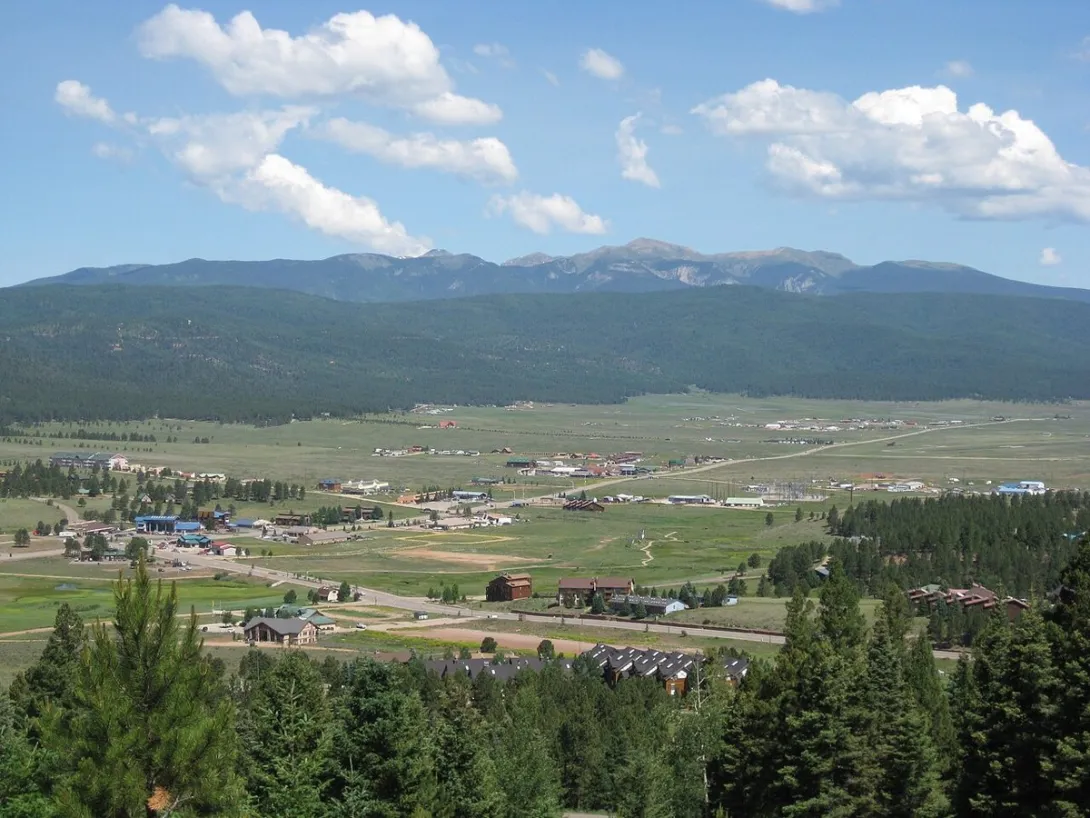
Stand in Angel Fire and look across the Moreno Valley, and the first thing you notice is how open it feels. The valley runs about twenty-seven miles from north to south and about five miles wide, with its floor at about eight thousand two hundred fifty-two feet. The Sangre de Cristo Mountains rise to the west and the Cimarron Range rises to the east, while Angel Fire and Eagle Nest sit on ground that looks calm and flat. That flat floor is not solid bedrock. It is a deep fill of sand, gravel, and rounded stone washed down from the mountains around it, and learning to read that fill is one of the best ways for a beginner to understand this country.
Click to see more photos of the Moreno Valley and Angel Fire
In their classic work on the valley, published by the United States Geological Survey, Ray and Smith described the Moreno Valley as a broad, northward-plunging syncline, a great downfold in the rock created during the Laramide mountain-building episode and broken by smaller folds and faults. They concluded that the valley began as a topographic feature near the close of the Mid-Tertiary, and that its later history was similar to the history of the Rio Grande depression to the west. As the high country rose, this basin sagged, and streams went to work filling it.
The fill has a name. The Eagle Nest Formation is the Pliocene valley fill named by Ray and Smith, made of coalescing alluvial fans, sheets of debris spread by streams where side canyons met the valley. Later summaries estimate about one thousand feet of fan debris in the downwarp, with remnants as much as four hundred forty feet thick still underlying the valley. A Geological Survey study of the placer districts added that the valley sediments include more than three hundred feet, in places, of locally derived, unconsolidated sand and gravel ranging in age from Pliocene to Holocene, and that some of those gravels correlate with the Eagle Nest Formation exposed in the southern valley.
A cobble in the valley fill did not necessarily form where it lies. It may have tumbled down from Proterozoic rocks in the Sangre de Cristos, from sedimentary slopes, or from younger intrusive country to the north, and then been rounded, sorted, and buried by water. The valley is a natural mixing bowl that rewards careful observation. Learning to tell transported valley gravel from bedrock in place, and to ask where a stone started its journey, is a safe and satisfying beginner skill. Photo by Davishan99, shared under a Creative Commons Attribution-Share Alike license, via Wikimedia Commons, showing the town of Angel Fire on the valley floor.
Know before you go
Collect only where legal, and confirm land status and the land manager's current rules before you collect anything. This article names no collecting site near Angel Fire, because no specific site was verified as open to collecting this week. Much of the Moreno Valley is private ranch and resort land, and the Baldy and Elizabethtown country is laced with patented and unpatented mining claims, where collecting requires the claimholder's permission. Never collect on private land without permission, on Angel Fire Resort property, in wilderness areas, in state parks, or at cultural sites, and never enter old mine workings. On Bureau of Land Management land, reasonable amounts may be collected for personal, non-commercial use with hand tools and only minor surface disturbance, and on national forest land the Forest Service directs collectors to check with the local ranger district first. Pack out what you pack in, and leave gates as you found them.