
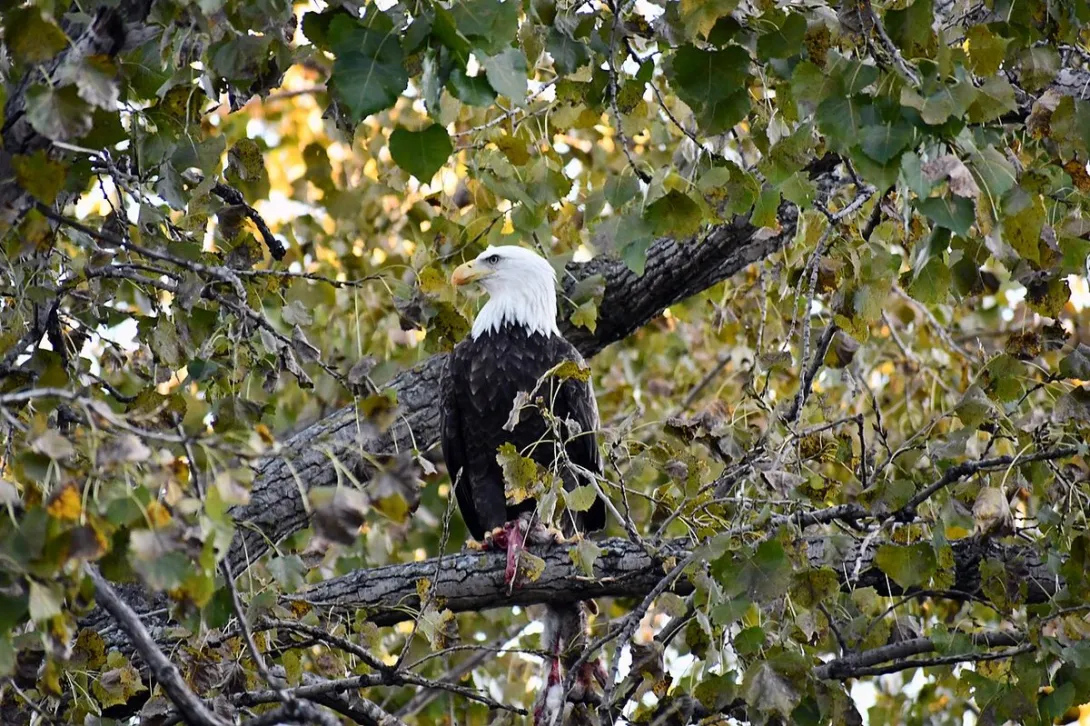
Late fall brings a quiet change to the Moreno Valley, and one of its most welcome signs appears in the tall trees around Eagle Nest Lake. As northern lakes begin to freeze, bald eagles move south in search of open water and food, and their numbers around Eagle Nest Lake increase during December and January. For Angel Fire residents and visitors, the short drive to the lake on the Enchanted Circle offers one of the best chances of the year to see these large raptors close to home.
Click to see more photos of bald eagles
Eagle Nest Lake State Park protects a 2,400-acre alpine lake at 8,200 feet in a glacial valley below Wheeler Peak, the highest point in New Mexico. The lake is regularly stocked with trout and salmon and also holds northern pike and yellow perch, giving fish-eating birds a reliable food base. The U.S. Fish and Wildlife Service notes that bald eagles need exactly this combination: a good food supply, perching areas, and waters such as large lakes and reservoirs. In winter, eagles congregate near open water in tall trees, where they can watch for prey.
An adult bald eagle is hard to mistake. It has a dark brown body and wings, a white head and tail, and a large yellow bill, with a wingspread of about seven feet. Young birds look very different, and they are easy to overlook or confuse with a golden eagle, which also becomes more common here in winter. Juveniles are mostly brown with white mottling on the body, tail, and undersides of the wings, and they do not gain full adult plumage until about their fifth or sixth year.
Bald eagles are opportunistic feeders, with fish as a staple, and they also take waterfowl and carrion when the chance arises. That flexibility helps them through a Moreno Valley winter, when ice slowly claims the lake and food concentrates along the remaining open water. Their presence is also a conservation success story. The Fish and Wildlife Service removed the bald eagle from the threatened and endangered list in 2007 after decades of recovery, and it now estimates about 316,700 bald eagles in the lower 48 states.
The best approach is slow and patient. Scan the treeline and the open water from the state park day-use areas, the lakeshore, and established pullouts along the Enchanted Circle, and use binoculars or a spotting scope so detail comes to you. An eagle may sit for a long time before dropping toward the water, and a morning spent watching one bird is often more rewarding than trying to find many. Golden eagles, osprey in warmer months, waterfowl, elk, and deer share this valley, so there is almost always something else to notice while you wait.
Know before you go
Watch wildlife ethically and give eagles plenty of room. Keep your distance, never feed wildlife, and stay on roads, trails, lakeshores, and established viewpoints. Do not approach a perched or feeding bird, and if an eagle changes its behavior because of you, back away. Sensitive exact locations for nesting raptors and other vulnerable wildlife are intentionally not shared. Dress for cold, windy weather at high elevation, check current park alerts before you go, and drive carefully on US-64 and NM-38, where wildlife may be near the road.