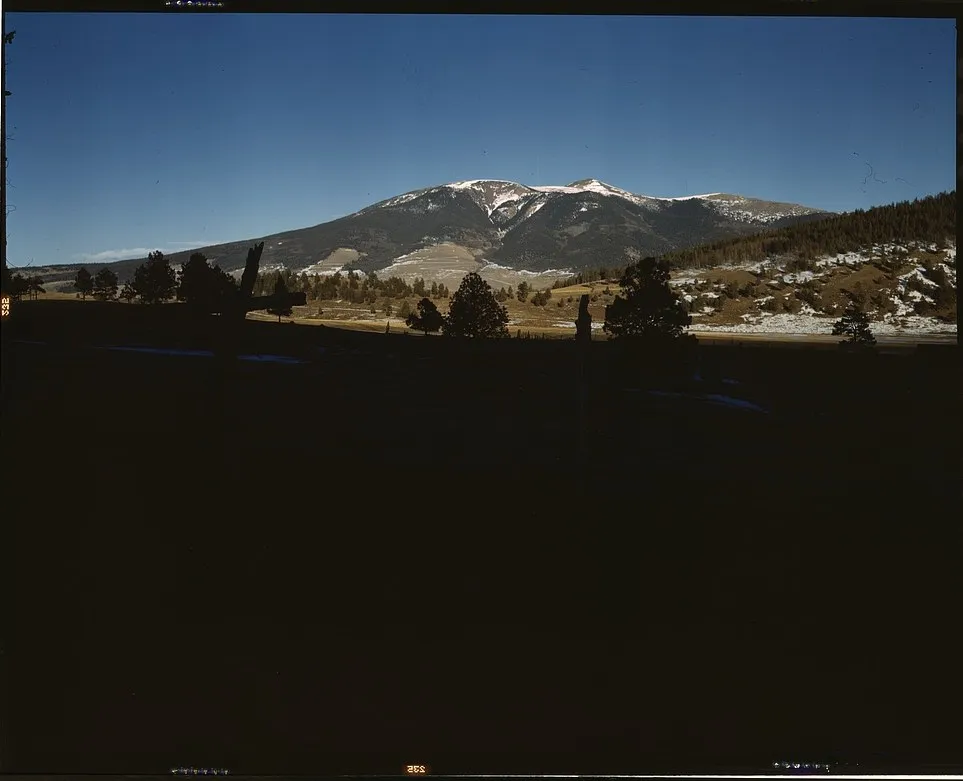
Stand anywhere in the Moreno Valley, look from Baldy Mountain down across the ranches and meadows toward Angel Fire, and you are looking across land that was once claimed as a single private estate. The Maxwell Land Grant was the largest land grant in United States history, and for decades nobody could say for certain how large it really was. Was it about 97,424 acres, or was it 1,714,765 acres? That question took a patent, a lawsuit, and the United States Supreme Court to answer.
Click to see more photos of the Moreno Valley — its meadows, mountains, and 1940s ranch country
It began on January 8, 1841, when Charles Beaubien and Guadalupe Miranda petitioned Governor Manuel Armijo of Mexico for land in northern New Mexico, describing it by rivers, hills, and the summit of a table-land rather than by surveyed lines. Armijo granted the request on January 11, 1841. The two men spoke of settling families on the land, and the records called it a colony. Beaubien's son-in-law, Lucien B. Maxwell, married Luz Beaubien, helped manage the grant, bought Miranda's share in 1858, and after Beaubien died in 1864 acquired most of the rest, so the Beaubien-Miranda grant became known by Maxwell's name.
Maxwell sold the grant in 1870, and the buyers organized as the Maxwell Land Grant Company, but the United States still had not issued its final patent. Congress had confirmed the grant on June 21, 1860, following a favorable report from the surveyor general of New Mexico. A government survey was later returned in December 1878, and on May 19, 1879, the United States issued a patent to Beaubien and Miranda, their heirs and assigns, for 1,714,764.94 acres lying partly in New Mexico and partly in Colorado. Under that patent, the title benefited the Maxwell Land Grant Company, which then owned the grant.
The federal government then tried to undo its own patent. On August 25, 1882, the United States filed suit in Colorado to have the patent set aside, charging that the survey was made fraudulently and that about 265,000 acres in Las Animas County, Colorado, had been wrongly included. An amended bill filed in December 1883 added a sweeping argument: under Mexican colonization law, a grant could not exceed eleven square leagues for each person, so Beaubien and Miranda together could have received no more than 22 leagues, the equivalent of 97,424 acres. On that reading, most of the patented grant, including gold country around Baldy Mountain and the Moreno Valley, should never have been private land at all.
The Supreme Court decided the Maxwell Land-Grant Case on April 18, 1887. The justices examined the colony language in the original petition and the Mexican authorities' own treatment of the grant, and they held that Congress, knowing the question, had confirmed the grant in 1860 to the full extent of its described boundaries. The court found no proof of the fraud or mistake needed to cancel the patent, and it affirmed the lower court decree dismissing the government's bill. The patent stood, at its full surveyed size.
That decision fixed the map the Moreno Valley still lives with. With clear title, the company could sell and lease the valley's ranch and mining lands for years. Moreno Valley rancher John W. Turner, for example, bought his 2,500 acres from the Maxwell Land Grant Company, and later Angel Fire lands were assembled out of those old grant holdings. When you drive the Enchanted Circle today, the fences, ranches, and resorts below Baldy trace back in part to a boundary argument that began with a petition in 1841 and ended, nearly half a century later, in the nation's highest court.