
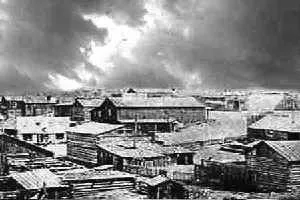
Elizabethtown's first boom burned fast. Gold found on Willow Creek in October 1866 turned the Moreno Valley camp into a town of thousands, but mining costs soon outweighed the ore coming out of the Baldy Mountain country. The settlement was reduced to about 100 residents, it lost the Colfax County seat to Cimarron in 1872, and by 1875 it was described as a virtual ghost town. Many mining towns never get another chance. Elizabethtown did.
Click to see more photos of Elizabethtown — its boomtown streets, mines, and the ruins that remain today
The second chance began in November 1878, when the Atchison, Topeka, and Santa Fe Railroad advanced its track from Trinidad, Colorado, into New Mexico. Ore that had once moved slowly and expensively by wagon could now be shipped much more cheaply, and investment in the Elizabethtown-area mines increased again, along with the population. Once the long Colfax County War had finally wound down in the late 1880s, the revival took hold in earnest during the 1890s. It was short and frenetic, and at one point the town's population climbed back to about 3,000 people.
The revived E-Town was more than a mining camp the second time around. Money collected from liquor licenses was earmarked for schools. The school baseball team arranged games against Catskill, Midnight, and Trinidad, and made its community proud by winning many of them. Footraces and boxing matches were common, and Saturday-night dances with a fiddle band were so popular that people traveled several miles over rough mountain roads to attend. When snow covered the roads, sleds replaced wagons, and the dancers arrived anyway, dressed in their most elegant clothes and on their best behavior.
Appearances could deceive, however. Several well-mannered young men who rode good horses, flashed plenty of money, and claimed to be cowboys became regulars at the dances, and the single women of E-Town were enraptured by their manners. Only later, when the men were captured, did townspeople learn that their polite dancing partners were members of Black Jack Ketchum's outlaw gang, which had robbed trains and stores across the region in the late 1890s. Ketchum himself was hanged at Clayton on April 26, 1901.
The second boom did not last. The great fire of September 1903 destroyed most of the wooden town, the mines again faded, and by 1917 few people still called Elizabethtown home. Even so, the 1890s revival is worth remembering, because it shows a community choosing to rebuild a life, with schools, ball games, and dances, and not only a mine. Today the stone ruins and the hillside cemetery remain along New Mexico State Road 38, about five miles north of Eagle Nest, a quiet stop on the drive between Angel Fire and Red River for anyone who wants to stand where E-Town came back to life.