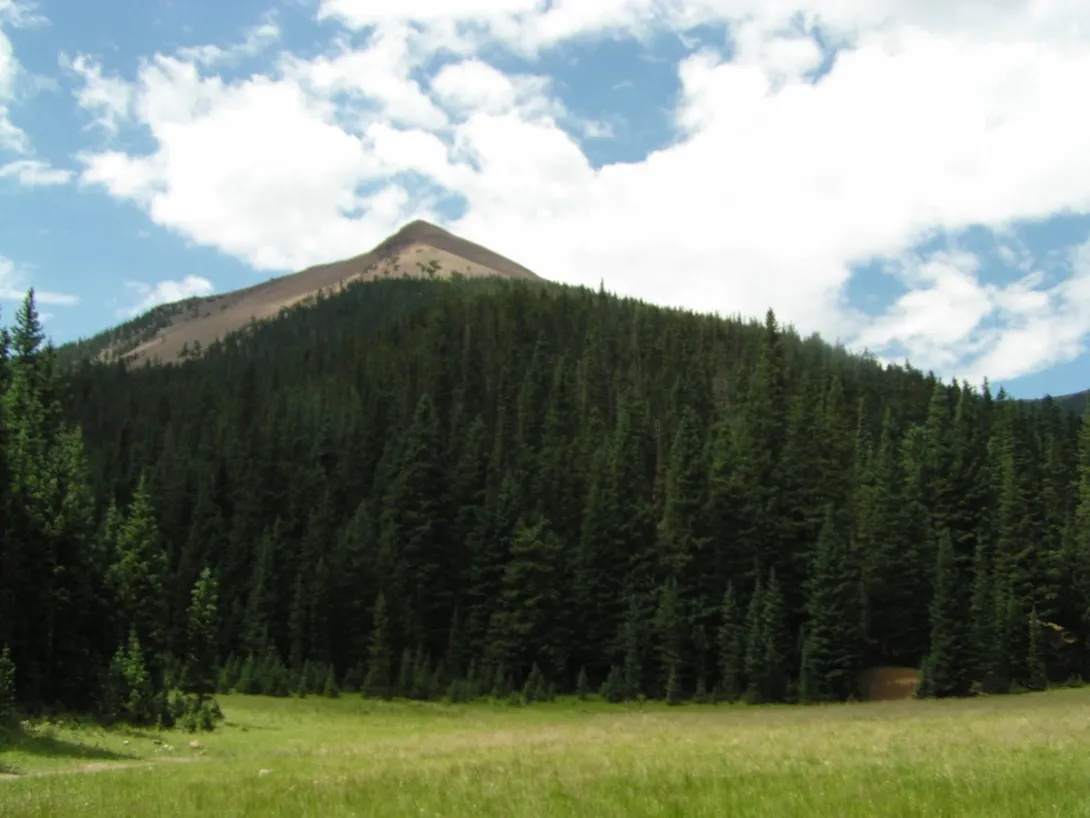
From Angel Fire, look northeast across the wide Moreno Valley and one summit commands the view. Baldy Mountain rises to 12,441 feet, the highest peak in the Cimarron Range, climbing about 3,640 feet above the valley floor in just a few miles. Its bare, treeless crown is beautiful, but for rockhounds it is also a lesson: the gold rush that built Elizabethtown began in the geology of this one mountain.
Click to see more photos of Baldy Mountain
The valley beneath Baldy is far older than any mine. Geologists with the New Mexico Bureau of Geology and the United States Geological Survey describe Moreno Valley rocks ranging from Precambrian basement to Quaternary valley fill, with thick upper Paleozoic sections folded and faulted over several eras. Beginning in the latest Cretaceous, Laramide folding and uplift shaped a broad syncline, later cut by high-angle normal faults tied to the rise of the Sangre de Cristo Mountains and the nearby Rio Grande rift. Mid to late Tertiary intrusions then pushed into that broken ground and changed everything for prospectors.
In the Elizabethtown and Baldy districts, those intrusions brought heat and mineral-rich fluids into fissures in the rock. The Bureau's regional geology notes that the district's fissure-vein gold and contact deposits are Oligocene in age, and that placer deposits formed afterward as weather worked the veins apart. When gold was found in Willow Creek on Baldy's west slope in 1866, prospectors followed the flakes upstream toward their lode source, filed claims across the gulches, and built Elizabethtown, the Moreno Valley's first boomtown. Mines with names like Aztec, Mystic Lode, French Henry and Montezuma followed, and old accounts describe many miles of workings threaded through the mountain for gold, copper and silver.
That source-to-stream story is the best rockhounding takeaway here. A placer flake in a gravel bar points uphill and upstream to a vein; white quartz, iron-stained rock and altered zones near an intrusion can be clues in the field guide sense, even where you are only looking and learning. Reading Baldy this way turns a scenic drive around the Enchanted Circle into a geology walk: valley fill below, folded Paleozoic rocks in the walls, and an intruded, mineralized peak at the head of the gulches.
Enjoy Baldy and Elizabethtown as mineral heritage, not as a collecting destination. The story explains where gold came from and why claims followed, while reminding today's visitors to admire specimens in place, learn the district from roads, museums and overlooks, and leave every hillside exactly as they found it.
Know before you go
Collect only where it is legal, and this district is not open collecting ground: much of the Moreno Valley is private ranch and resort land, Baldy is laced with patented and unpatented mining claims and Philmont Scout Ranch land, and collecting on an existing mining claim is prohibited without the claimholder's permission. Never enter old mine workings, and do not collect on private land without the owner's permission. On Bureau of Land Management land elsewhere, rockhounds may generally collect reasonable amounts for personal use with hand tools that cause only minor surface disturbance, not in developed recreation sites unless permitted, and they should check with the local BLM office and posted signs first. Pack out what you pack in.